Safety
Ostomy blockage: foods, warning signs and what to do
A food blockage happens when food collects where the bowel exits through the stoma. It is mainly a risk with an ileostomy. Know the signs and when to get help.
General information, not medical advice. Your surgeon, ostomy nurse or dietitian may give you different instructions for your surgery and your body; follow theirs first. Medical disclaimer.
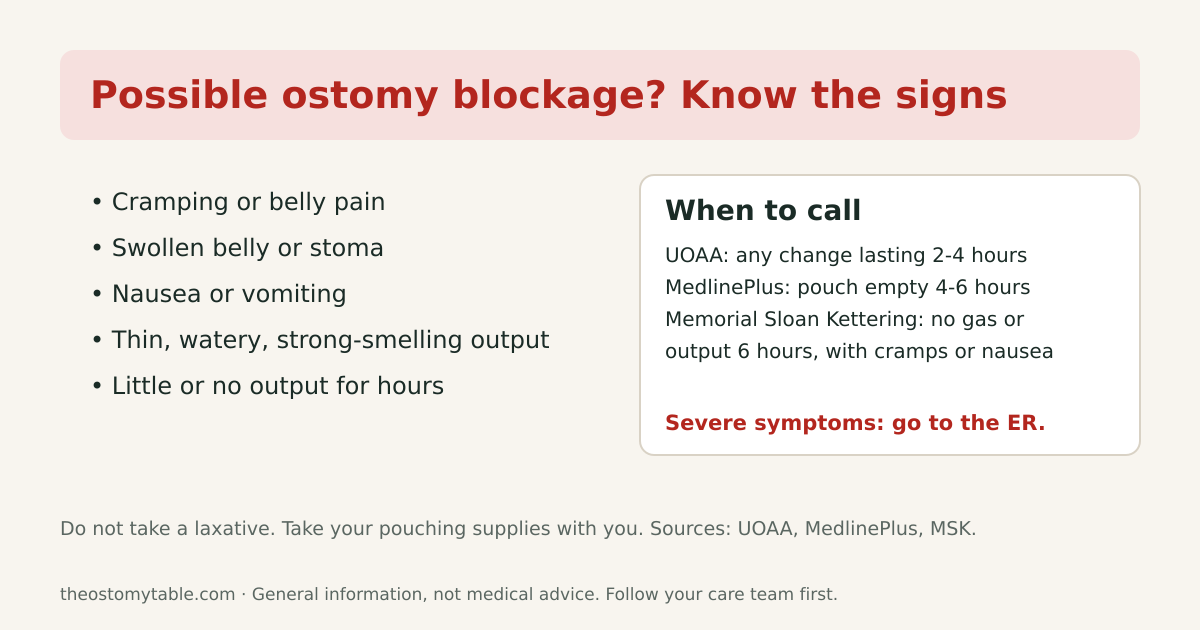
Get help now if you have no output for several hours with belly pain or cramping, vomiting, a swollen belly, or a stoma that is swollen or much darker than usual. Call your doctor, or go to the emergency room if you cannot reach them. Take your pouching supplies with you.
What a food blockage is
Large pieces of food that do not break down well can get stuck where the intestine passes through the belly wall to the stoma. UOAA explains that people with an ileostomy are at greater risk because the stoma made from the small intestine is narrower, and the bowel is swollen after surgery.
A blockage can also have causes other than food, such as scar tissue after surgery. UOAA advises calling your doctor or going to the hospital if stool is not coming out, so they can tell which it is.
Warning signs
Sources describe these signs:
- Cramping or belly pain, near the stoma or across the belly
- Swelling of the belly or the stoma
- Thin, watery output with a strong odor, which can progress to no output
- Little or no output, or pressure at the stoma with little coming out
- Nausea or vomiting
- Less urine, or dark urine, as dehydration sets in
How long is too long without output?
Sources set different time limits, which is one more reason to know your own team's rule:
- UOAA's blockage card says to call your provider's office about any change in function lasting more than 2 to 4 hours, even without pain or vomiting.
- MedlinePlus says to contact your provider right away if the pouch stays empty longer than 4 to 6 hours.
- Memorial Sloan Kettering says to call if there is no gas or output for 6 hours along with cramps, pain or nausea.
Foods most often linked to blockages
These appear on the blockage lists from UOAA and hospital guides: popcorn, nuts and seeds, whole-kernel corn, celery, coconut, mushrooms, dried fruit, fresh pineapple, coleslaw and raw cabbage, fruit skins and peels, grapes, citrus pith, and some Chinese vegetables such as bok choy and bamboo shoots. See all blockage-risk foods.
These foods are not banned forever. UOAA says to eat them with caution, wait until 4 to 6 weeks after surgery, add them one at a time, and chew well.
Prevention
- Chew thoroughly. If you see chunks of food in your pouch, UOAA says that is a sign you are not chewing enough.
- Cook vegetables and fruit well, or use canned, and skip skins at first.
- Keep portions of high-fiber foods small when you start them again.
- Stay hydrated.
Do not take a laxative
MedlinePlus and Memorial Sloan Kettering both say not to take a laxative if you think you have a blockage. Call your provider.
What UOAA suggests while you call
If you have no output but are not nauseated or vomiting, UOAA's blockage card describes steps such as switching to liquids only (juice, warm broth or tea), a warm bath, gentle walking and changing position, such as knees to chest. If you have pain or vomiting, call your doctor or go to the emergency room first. UOAA's emergency blockage card is worth printing and keeping with your supplies.
Common questions
What foods cause an ostomy blockage?
The most commonly listed are popcorn, nuts and seeds, corn, celery, coconut, mushrooms, dried fruit, fresh pineapple, coleslaw and raw cabbage, fruit skins, grapes and citrus pith. It is mainly a risk with an ileostomy.
How do I know if my stoma is blocked?
Signs include cramping, a swollen belly or stoma, nausea or vomiting, and little or no output, sometimes after a period of thin, watery, strong-smelling output. Call your provider; go to the emergency room if symptoms are severe.
Can a colostomy get blocked by food?
Sources say people with an ileostomy are at greater risk, because that stoma is narrower. Anyone with no output and belly pain should call their care team.
Should I take a laxative for an ostomy blockage?
No. MedlinePlus and Memorial Sloan Kettering both say not to take a laxative if you think your stoma is blocked. Call your provider.
Sources
Last checked November 27, 2026.
- ostomy.org/wp-content/uploads/2020/10/Ileostomy_Blockage_2020.pdf
- ostomy.org/wp-content/uploads/2022/02/Eating_with_an_Ostomy_2022-02.pdf
- ostomy.org/wp-content/uploads/2022/02/Food_Reference_Chart_2022-02.pdf
- medlineplus.gov/ency/patientinstructions/000074.htm
- mskcc.org/cancer-care/patient-education/diet-guidelines-people-ileostomy
- health.ucdavis.edu/surgery/documents/ileostomy-nutrition.pdf
- nm.org/conditions-and-care-areas/gastroenterology/digestive-health-center/interv
Foods on this page
- CeleryVegetablesEarly: avoid at firstBlockage riskUsually not in the first weeks. Celery is stringy, and it is on the blockage lists from UOAA, MedlinePlus and hospital guides.
- CoconutFruitEarly: avoid at firstBlockage riskUsually not in the first weeks. Coconut is on the blockage lists from UOAA, MedlinePlus and hospital guides.
- ColeslawVegetablesEarly: avoid at firstBlockage riskUsually not in the first weeks. Coleslaw is raw shredded cabbage and is on the blockage lists.
- CornVegetablesEarly: avoid at firstBlockage riskUsually not in the first weeks. Whole-kernel corn is one of the best-known blockage foods.
- Dried fruitFruitEarly: avoid at firstBlockage riskUsually not in the first weeks. Dried fruit is on the blockage lists from UOAA, MedlinePlus and hospital guides.
- MushroomsVegetablesEarly: avoid at firstBlockage riskUsually not in the first weeks. Mushrooms of all types are on the blockage lists. They can also add odor.
- NutsMeat, fish, eggs and beansEarly: avoid at firstBlockage riskUsually not in the first weeks. Whole nuts are on the blockage lists from UOAA, MedlinePlus and hospital guides, and can also cause gas.
- PineappleFruitEarly: avoid at firstBlockage riskUsually not in the first weeks. Fresh pineapple is on the blockage lists from UOAA, MedlinePlus and hospital guides. Even canned pineapple is left off the early canned-fruit lists.
- PopcornSnacksEarly: avoid at firstBlockage riskUsually not in the first weeks. Popcorn is on the blockage lists from UOAA, MedlinePlus and every hospital guide we use.